Making the Case for a Compensation Investment: Five Rules for Winning the Budget Fight
Boyd Davis, Co-founder, Payfederate®
| TL;DR
The case for better market data, outside expertise, or new comp technology rarely needs defending to the person who’s asking. It needs defending to finance or general management. Win that fight by refusing to sell efficiency, tying the ask to a metric your CFO already owns, committing to a number you could be held to, bringing a sponsor who isn’t from HR, and shrinking the ask until turning you down costs more than approving it. |
I came to compensation, and to startups, late. I spent the first half of my career at a large industrial company on both sides of budgeting — pitching projects, then sitting on the committee deciding whose got funded and whose got shelved. That’s a budget-committee background, not a comp background, and it’s the one I use when I sit in on a customer’s internal pitch.
Leading Payfederate puts me on the other side of a different table now, and the pattern is remarkably consistent: we rarely lose deals because a comp practitioner failed to build the case. The case is almost always right. We lose deals because the practitioner never got a hearing from the person who could say yes — and for many if not most organizations, that person sits in finance or general management, not HR.
If you already believe fair, competitive pay is one of the highest-leverage levers in your business, you don’t need me for that part. What you need is a way past the person standing between you and the money — and these five rules are the ones I’ve watched actually move it.
Read the Room Before You Write the Memo
Finance isn’t short on ideas to fund right now. It’s funding a different list. CFOs have spent three straight budget cycles pulling back on planned compensation increases while pushing technology spend harder every year, per Gartner’s ongoing CFO tracking — and every comp leader walking into a budget review is competing against that shift, whether they’ve named it or not.
Don’t fight that current. Use it. A proposal that reads like an operating investment with a measurable return gets funded out of a different bucket than a request on behalf of the comp team — and that distinction is where most comp pitches lose before they’ve said a word about pay.
Rule One: Kill the Efficiency Pitch Before Someone Else Does
I’ll say the part most vendors won’t.
Better market data, an outside job-architecture consultant, new comp software — all of it makes a comp team’s life measurably easier, and every vendor selling into HR, us included, leads with exactly that pitch because it’s true and easy to say. It’s also the fastest way to get your request tabled. Whatever the town-hall deck says about being “people first,” when a budget gets trimmed, “makes HR’s life easier” is the first line struck.
Mention the efficiency gain once, in passing, and move on. The rest of the pitch has to be about what changes outside the comp function. Here’s the exact swap I coach customers through before it ever reaches a slide:
| What you’re tempted to pitch | What finance actually hears | What to pitch instead |
| “We need a second benchmark data source.” | A nice-to-have for the comp team. | “This closes a pay gap that’s driving offer declines in [role family].” |
| “This software makes benchmarking faster.” | An efficiency tool. | “This cuts time-to-fill on critical roles by weeks, not days.” |
| “This helps us get ahead of pay equity. | An effort at social engineering | “This protects us from the retention and regulatory risk of perceived unfair pay.” |
Rule Two: Speak the Metric That’s Already on Your CFO’s Dashboard
For most commercial businesses, that’s revenue or margin. For public-sector and nonprofit organizations, it’s a different number, but still not a comp metric. Compa-ratio and position-to-market matter to your CHRO; they mean nothing to the SVP signing off on your budget until you translate them. Uncompetitive or unfairly perceived pay shows up on that leader’s own dashboard as turnover, a hiring pipeline that takes longer every quarter, and a team that’s quietly checked out.
The math is not soft. Replacing an employee typically runs 50% to 200% of annual salary once you count lost productivity, ramp time, and manager hours, and voluntary turnover costs U.S. employers roughly $1 trillion a year in aggregate.
| Role level | Replacement cost | On a $100K role |
| Entry-level / individual contributor | 30–50% of salary | $30K–$50K |
| Specialized / technical | 100–150% of salary | $100K–$150K |
| Manager / director | 150–200% of salary | $150K–$200K |
| VP / C-suite | 200–400%+ of salary | $200K–$400K+ |
Source: SHRM Benchmarking Data 2025; Gallup State of the Global Workplace 2025.
Pay drives more of that bill than most finance leaders want to admit — 44% of workers said in one 2024 survey that they’d leave for a bigger paycheck elsewhere, full stop. Take the metric your budget owner already tracks and hand it back as the pay problem you’re proposing to fix. You’re no longer asking them to care about compensation. You’re asking them to protect a number they already report on.
Rule Three: Put a Number on the Table You Could Be Held to
This is where most comp leaders flinch — HR has spent a decade getting comfortable with soft indicators: improved engagement, stronger employer brand. Finance does not fund soft indicators. If you’re asking for $50,000, don’t promise better data. Promise a 10% reduction in regrettable attrition on a named list of roles, by a named date. Hit that number and it pays for itself several times over before anyone asks you to justify the next request.
- Pick one indicator finance already tracks — regrettable attrition, offer-acceptance rate, time-to-fill for critical roles.
- Attach a number and a date to it, not a direction.
- Report the number in the quarter it’s ugly, not just the quarter it isn’t — that’s what earns the next budget, not the win itself.
There’s a real lever behind this, not just discipline for its own sake. Employees who believe they’re paid unfairly are 45% more likely to start job hunting regardless of what they actually earn, while employees at companies with high pay transparency are 59% less likely to leave at all. Perception moves faster than payroll, and it’s the variable your budget can actually shift inside a single quarter.
Rule Four: Don’t Walk Into the Room Alone
We’re in the middle of the biggest realignment of work in a generation, driven by AI, and most organizations have already assigned a visionary executive to own it — someone who needs quick, visible wins and is actively hunting for them. You’ll also find a business leader living the symptoms of a pay problem firsthand: regrettable exits, a hiring pipeline stalled for months, people who’ve quietly stopped raising their hand. That leader is a far more willing co-sponsor than HR usually assumes.
Find that name before you write the proposal, not after finance asks who else supports it. A co-sponsor from outside HR changes how the ask gets read in the room — I’ve seen it flip a no into a yes with the exact same numbers on the page.
Rule Five: Shrink the Ask Until Saying No Costs More Than Saying Yes
You may be picturing the full build: three benchmark sources instead of one, new comp software, a consultant rebuilding your job architecture. That end state is a genuinely world-class capability, and it’s also not what you lead with. Start smaller, and strip out every source of risk before the number reaches a signature.
At Payfederate, we sell three-year subscriptions but don’t incentivize them, because we’d rather re-earn the business every year. Every customer trials the product first or has a real opt-out if implementation goes sideways — a deliberate way of making the first yes cheap to give. Push your own vendors, and your internal proposal, to the same standard.
Wins compound. Make sure the first one is a sure thing, even if it’s a fraction of what you actually want.
A Better Seat at the Table, Even When the Budget Doesn’t Move
Run this playbook and you may still not get the budget on the first pass. You will get a better seat at the table, and the next ask gets easier because of it. What we all do here is genuinely important, and it’s on us to make the argument in a language the budget owner already speaks, not the one we wish they spoke.
Explore Payfederate and see how market pricing, job architecture, and compensation data from multiple sources work together in one connected platform, with a trial period built in from the start.
Navigating the Modern Salary Benchmark Data Market: How to Build a Smarter Compensation Benchmarking Strategy
Boyd Davis, Co-founder, Payfederate®
TL;DR
The market for salary benchmark data has multiplied — traditional surveys, aggregators, job postings, offers data, employee-reported platforms — and most organizations are still buying it the way they did a decade ago. Modern salary benchmarking means treating market data as a governed process, not an annual purchase order.
I’ve lost count of how many budget reviews start the same way: someone pulls up the vendor list for compensation data spend and realizes nobody can say, with a straight face, which survey is actually driving pay decisions anymore. Two or three subscriptions covering nearly identical job families, renewed on autopilot, year after year, because switching or consolidating always feels riskier than just paying the invoice again.
That pattern is more common than most C-suite leaders would guess. Salary benchmarking used to mean picking one survey provider, submitting your incumbent data once a year, and waiting for a report.
Today, building a sound compensation benchmarking strategy means navigating a market that includes legacy consulting surveys, data aggregators, real-time job-posting feeds, offer-based data, and employee-reported platforms — often all at once, purchased by different people, for different reasons, with no shared governance.
Getting salary benchmarking right in 2026 isn’t about finding the “best” provider. It’s about building a purchasing and usage strategy that survives vendor changes, catches bad data before it reaches a pay decision, and blends sources instead of betting the entire compensation benchmarking function on one
The Market Got Crowded Before Anyone Redesigned the Process
For decades, salary survey data came from a small handful of names — Mercer, WTW, Radford, — and the buying process was simple because the market was simple. That’s no longer the case.
Real-time job-board data, self-reported salary platforms, and offer-tracking tools have all entered the compensation benchmarking conversation, usually positioned as faster, cheaper alternatives to the legacy players.
They’re not replacements. They’re additional inputs. Treating any single source — old or new — as the whole answer is where most of the risk in a modern salary market analysis actually lives.
Best Practice One: Decouple Your Process From Any Single Data Source
Every salary survey you buy is, in practice, a vendor-specific benchmark. It comes bundled with that provider’s job codes, matching methodology, and update schedule. Wire your job architecture and market pricing logic directly to one provider’s structure, and switching vendors — or simply adding a second source — turns into a multi-quarter rebuild instead of a configuration change.
A few things that make this decoupling real rather than aspirational:
- Keep your own job architecture and level definitions as the system of record; treat every survey as a mapped input, not the foundation itself
- Build or buy a matching layer that can translate your roles into any vendor’s job codes, not only the one you use today
- Make sure you can renegotiate, add, or drop a provider without re-benchmarking your entire organization from scratch
The single biggest mistake I see compensation teams make is designing their entire market pricing process around the assumptions of whichever survey they happened to buy first. That decision quietly becomes permanent, long after the reasoning behind it is forgotten.
Best Practice Two: Use Multiple Surveys, Not Just One
This is one of the more well-documented realities of compensation benchmarking, and the data backs it up. A 2024 CompTool survey of more than 500 HR and compensation professionals found that only about one in five organizations rely on a single salary survey data source.
Roughly three-quarters use two or three sources per job, and companies with a dedicated market pricing tool subscribe to noticeably more surveys on average than those managing the process manually.
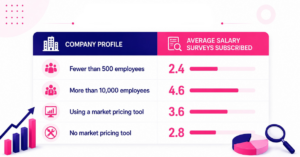
Source: CompTool, Salary Benchmarking Best Practices Survey, 2024
The logic holds up, and it keeps your salary market analysis grounded in more than one vendor’s point of view: no single survey covers every role, industry cut, and geography with equal rigor. Blending sources smooths out the gaps — a thin sample size in a niche job family, weak coverage in a specific market, one provider’s particular quirks in how they collect compensation data. The tradeoff is added complexity, which is exactly why the process needs to be decoupled from any one vendor in the first place.
Best Practice Three: Monitor Usage Like You Would Any Major Contract
Salary survey subscriptions routinely run $10,000 to $30,000 a year per source, and larger enterprises subscribing to four or more surveys are easily spending six figures annually on compensation data. Very few organizations can say, with real confidence, which surveys actively inform pay decisions and which are renewed out of habit.
- Track which surveys actually get cited in market pricing decisions, not just which ones get purchased
- Set a defined review cadence — A strong plurality of organizations validate their market matches roughly every 12 months, which tends to line up with typical survey refresh cycles
- Flag overlapping coverage before renewal season arrives, not after the invoice does
This is the least glamorous best practice on this list, and the one most often skipped. But an unaudited salary survey data budget is one of the easiest six-figure line items to quietly overspend, year after year, without anyone noticing.
Best Practice Four: Apply Alternative Data Sources Carefully
Not all compensation data is built the same way, and treating it as if it were is where a lot of salary benchmarking programs get into trouble.
It helps to separate the market into two broad categories: survey data, which is collected directly from participating employers through a structured process, and derived data, which is modeled or aggregated from public records, job postings, HRIS feeds, or accepted offers rather than submitted by employers directly.
Both have a place in a modern compensation benchmarking strategy. Neither should be used blind.
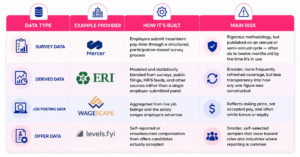
Used well, this distinction sharpens a salary market analysis considerably — derived data and job-posting data can flag where the market has moved faster than your last survey cycle, and offer data can validate whether your ranges are actually winning candidates. Used carelessly, they introduce a different kind of noise: an advertised range is a starting position, not a settled salary, and a modeled estimate is only as good as the inputs behind it.
Treat derived data as a directional check against your primary compensation data, not a wholesale replacement for it.
Building a Salary Benchmarking Strategy That Survives the Next Vendor Change
None of these four practices works in isolation.
A market pricing process that isn’t decoupled from its data source can’t meaningfully use multiple surveys. A budget nobody monitors will keep paying for redundant subscriptions. And alternative data applied without discipline just adds one more uncoordinated input to a process that’s already fragmented.
At Payfederate, this is precisely the problem our market pricing module was built to solve: compensation data from multiple surveys, blended and matched inside the same environment where your job architecture and pay bands already live, so adding or switching a source doesn’t mean starting over.
Salary benchmarking shouldn’t be the most brittle part of your compensation strategy. With the right process behind it, it can be the most reliable one.
Explore Payfederate and see how salary benchmarking, market pricing, and compensation data from multiple sources can work together in one connected platform.
Your M&A Integration Is a Project. Your Compensation Platform Should Be Permanent.
Boyd Davis, Co-founder, Payfederate®
There is a moment that most compensation professionals recognize. The deal closes, the handshakes happen, and someone in HR gets an email — or sometimes just an invitation to a meeting — that says, effectively: “We need to figure out pay.”
That email usually arrives with a project code, a timeline, and a set of deliverables that feel manageable. Normalize the job descriptions. Align the career levels. Merge the pay ranges. Six months to a year. Done.
This is where most compensation integrations go wrong — not in the execution of the project, but in the framing of it as a project at all.
The Problem With Treating Compensation Integration as a One-Time Event
Here is the reality: every task in a compensation integration is also a task in ongoing compensation management. Normalizing job descriptions is not something you do once after a merger — it is something a living organization needs to do whenever roles evolve, which is constantly. Merging pay ranges is not a deal-related activity — it is what you call an annual market refresh in any other context.
When companies treat compensation integration as a time-limited project, they tend to use time-limited tools. Spreadsheets. Shared drives. A consulting engagement that ends when the deliverables are signed off. The project closes, the consultants leave, and six months later the carefully built framework starts to drift. Ranges go stale. Job descriptions stop getting updated. Career level consistency erodes as managers make informal exceptions.
Within two years, the integrated organization is managing compensation with the same ad-hoc practices it started with — only now with twice the complexity.
| The data is uncomfortable: 83% of M&A practitioners cite poor integration execution — not strategic misfit — as the primary cause of deal failure. Employee turnover in Year 1 post-merger averages 47%. The value you acquired walks out the door when people feel uncertain about where they stand |
The Five Workstreams — and Why Each One Is Permanent
A well-run compensation integration has five core workstreams. Here is the insight that changes how you approach all of them: each one maps directly to a capability any compensation function needs permanently. The integration is not a special project — it is your compensation infrastructure, built under urgency.
- Normalizing job descriptions: You cannot benchmark a role you cannot define. Two organizations entering a merger typically bring incompatible job description libraries — different formats, different competency language, different levels of rigor. The normalization work is real and it is urgent. But once it is done, it needs to stay done. Roles evolve. New functions emerge. The job description library requires ongoing governance, not a one-time cleanup.
- Aligning career levels: A Level 4 at Company A may represent the same scope as a Level 6 at Company B. Getting these aligned requires building a unified framework with clear, objective criteria. That framework then needs active maintenance. Without it, levels drift and pay equity erodes — not because anyone intended it, but because organizations change and no one is managing the framework.
- Merging market competitiveness principles: Two organizations rarely share the same pay philosophy. One targets the 50th percentile; the other the 65th. One benchmarks quarterly; the other annually. One considers total compensation; the other focuses narrowly on base. Reconciling these differences requires a clear, leadership-endorsed pay philosophy — and then a permanent process for applying it. Annual benchmarking is not optional in a competitive talent market.
- Identifying redundancies: This workstream carries the most legal and reputational risk. Decisions about which roles are redundant, who transitions, and who exits need to be made against objective, documented criteria. The integrity of that process matters enormously — for the people affected, for the remaining workforce who are watching, and for the organization’s ability to defend its decisions if challenged. The same rigor required for redundancy analysis is the rigor required for any ongoing workforce planning activity.
- Merging pay ranges: This is the most visible deliverable and the one most directly felt by employees. Building ranges that are market-aligned, internally equitable, and calibrated to a unified pay philosophy is the core task. But the first version of those ranges is not the final version. Markets move. What is competitive today may be below median in 18 months. Pay ranges need to be refreshed on a defined cycle, with a clear process for modeling budget impact and managing employees who fall outside the new structure.
What Integration Reveals About Your Existing Practices
One of the most valuable — and often uncomfortable — outcomes of a well-run compensation integration is what it reveals about both legacy organizations.
In virtually every merger, the integration process uncovers problems that existed before the deal closed. Job descriptions that no longer match the work being done. Career levels applied inconsistently across business units. Pay equity gaps that were invisible because the data lived in separate systems. Pay practices that relied on manager discretion rather than a documented framework.
These are not merger problems. They are compensation management problems that the merger made visible.
The organization that approaches integration with this lens — not just “how do we combine two systems” but “how do we build something better than either of us had” — is the organization that will see lasting value from the deal.
The Platform Question
At some point in every integration, someone asks: what tool are we going to use?
The answer to that question has long-term implications that most deal teams do not fully consider. If the answer is a spreadsheet-based approach or a project-specific tool, the organization is accepting that it will need to migrate to a permanent platform later — at the cost of rework, data integrity risk, and the loss of institutional knowledge that tends to leave with the integration team.
The better answer is to use the permanent platform from the start. Not a tool designed for integration that you will eventually sunset, but the tool you want to be running compensation on in five years — and use the integration as the moment to implement it properly.
This is the case that Payfederate makes. Every capability relevant to a compensation integration — AI-powered job description management, job architecture frameworks, market benchmarking, pay range administration, pay equity analysis — is the same capability required for ongoing compensation management. The integration is not a special use case. It is the standard use case, operating at scale.
| Companies that treat integration as a core competency — not a one-off crisis — consistently outperform those that approach each deal as an emergency. The data shows a swing of 8.5 percentage points in Total Shareholder Return between experienced and inexperienced acquirers. The experience that matters is not deal-making experience — it is integration infrastructure. |
What Good Looks Like
The organizations that handle compensation integration well share a few characteristics. They start earlier than they think they need to — ideally before close, with a data audit and preliminary gap analysis already underway. They treat the compensation function as a core integration workstream, not an afterthought to the IT and operational priorities. They choose tools based on what they will need permanently, not what is fastest to stand up.
Most importantly, they do not declare the project finished. When the new ranges are published and the leveling framework is documented, the integration team does not celebrate and disband. They hand off to an ongoing process. The go-live date is not the end — it is the beginning of a more mature approach to compensation management.
That is what the best compensation integrations produce: not just a harmonized pay structure for the combined organization, but a permanently better compensation function. One that can handle the next acquisition more efficiently, manage pay equity with rigor and confidence, and give employees a clear and defensible answer to the question they will always eventually ask: how was this decided?
The Bottom Line
M&A compensation integration is, at its core, just compensation management at an accelerated pace and elevated stakes. The workstreams are the same. The competencies required are the same. The data needed is the same.
The only thing that makes it feel like a special project is the urgency. And the best way to use that urgency is to build the infrastructure that should have been there all along.
Build it during the integration. Maintain it forever. The tool that gets you through the merger is the tool that makes every compensation decision after the merger better.
About Payfederate
Payfederate is an AI-powered compensation platform for job pricing, salary ranges, pay communications, and job offers. Download the M&A Integration Guide to know more.
Pay Compression Is Rising: How Companies Can Fix It Before It Hurts Retention
Michael Dressler, Director of Business Development, Payfederate®
Most compensation issues do not arrive with a clear warning sign. They build slowly inside systems that appear to be functioning normally. Salary reviews are completed, annual increases are approved, and hiring continues without any visible disruption. On paper, compensation looks managed.
The tension usually becomes visible somewhere else.
A senior employee realizes a recent hire in a comparable role is earning almost the same amount. A manager notices that a promotion increase no longer feels meaningfully promotional. Internal conversations around fairness become harder to navigate, even when no formal complaint has been raised. By the time leadership starts sensing a retention problem, the compensation issue has often been sitting underneath it for months.
This is where pay compression enters the picture.
At its simplest, pay compression occurs when the salary gap between newer hires and more experienced employees becomes too narrow to reflect tenure, expertise, or long-term contribution in a meaningful way. DCI Consulting has identified this as a growing challenge for employers that have made repeated market-rate hiring adjustments while moving incumbent employees through far slower annual increase cycles.
The reason it becomes dangerous is that pay compression rarely looks dramatic in a spreadsheet. Salaries may still fit inside approved pay ranges. Compensation policies may still appear compliant. Yet employees do not experience compensation through midpoint charts. They experience it through comparison, and comparison has become much easier in a labor market where pay information travels quickly.
How Companies End Up Creating It
Very few organizations create pay compression because they are inattentive. Most create it because they are trying to solve immediate hiring realities.
Over the last few years, employers have had to raise starting salaries to remain competitive in tight talent markets. Hard-to-fill technical roles, niche specialists, and high-demand business functions have all pushed offer ranges upward. Mercer’s recent U.S. salary planning data showed average merit increase budgets sitting around 3.6 percent, which means current employees are often moving incrementally while incoming talent is entering at aggressively adjusted market rates.
That disconnect compounds over time.
A hiring manager makes an exception to close a candidate. Another business unit pushes above midpoint because a role has stayed open too long. Meanwhile, existing employees continue progressing through standard percentage increases. Each decision seems reasonable in isolation, but collectively they begin flattening the salary structure.
This is the part many companies miss. They are paying close attention to external competitiveness, but not enough attention to internal salary separation.
As a result, the organization may remain market-aligned while becoming internally compressed.
Why Retention Starts Slipping Before Companies Connect the Dots
Pay compression tends to hit the employees who are hardest to replace.
Experienced contributors know what they bring to the business. They also have a strong sense of what the market is willing to pay for that experience. Once they begin to notice that their salary sits uncomfortably close to a newer hire with far less institutional knowledge, the compensation conversation changes in tone.
It is no longer just about whether the company pays competitively. It becomes a question of whether the company still rewards progression in a way that feels credible.
That perception matters more than many leaders assume. According to BambooHR research cited by SHRM, nearly 73 percent of employees say they would consider leaving for better compensation. The risk is not simply that employees want more money. The deeper issue is that compressed salary relationships make long-term growth inside the organization feel less meaningful.
When that happens, several things tend to follow:
- Promotions lose some of their motivational value
- Managers struggle to justify pay decisions convincingly
- High performers become more responsive to external outreach
- Internal trust in the broader compensation strategy begins to weaken
This is why pay compression is rarely just a payroll issue. It becomes a retention and confidence issue very quickly.
Why Compensation Benchmarking Alone Will Not Solve It
When companies finally identify the problem, the immediate response is often to run compensation benchmarking reports. Leadership wants to know whether salaries are still competitive against the market.
That is an important exercise, but it only answers half the question.
External benchmarking tells you whether your offers are sufficient to attract talent. It does not tell you whether your internal salary relationships still make sense. An organization can benchmark well against market medians and still have very little visible pay progression between a recent hire and a tenured incumbent.
This is where stronger compensation management becomes critical. The more useful analysis is not simply “Are we paying enough?” but:
- How much overlap now exists between new hires and experienced incumbents?
- Are promotional increases still creating visible salary progression?
- Have salary bands shifted enough to preserve internal differentiation?
- Are critical performers financially distinguishable from market-corrected hires?
At Payfederate, this is often where compensation teams realize they are not looking at a few isolated salary anomalies. They are looking at a framework that has gradually become less persuasive as market hiring moved faster than internal salary architecture.
What the Fix Actually Looks Like
This is not a problem that gets solved with a handful of retention raises.
Selective salary corrections can quiet individual concerns, but they do not rebuild confidence in the compensation structure. If the underlying framework still allows salary relationships to flatten, the same issue returns within the next hiring cycle.
A more durable correction usually starts with discipline in four areas:
- Tighter pay ranges: Broad or outdated pay ranges make compression harder to detect until employees begin clustering too closely.
- Cleaner job descriptions: Inconsistent or loosely written job descriptions make salary progression difficult to explain and defend.
- Skills based compensation: Critical capabilities should create visible salary distinction, especially in technical or scarce-skill roles.
- More continuous review cycles: Compensation movement needs to be monitored throughout the year, not only during merit planning.
This is where many organizations are being forced to rethink their broader compensation strategy. Annual spreadsheet reviews are no longer enough in a labor market where hiring premiums and skill valuations shift continuously.
Why Waiting Usually Makes the Correction More Expensive
Pay compression does not usually trigger immediate resignations. What it creates first is quieter disengagement.
Employees become less motivated by internal progression because the salary upside feels modest. Managers find pay conversations increasingly difficult. Recruiter calls begin sounding more attractive than they did a year ago. By the time turnover data clearly reflects the issue, the dissatisfaction has already had time to settle in.
A healthy compensation framework should do more than help a company hire competitively. It should preserve visible distinctions between entry, development, expertise, and long-term contribution.
That requires stronger compensation benchmarking, more proactive compensation management, disciplined pay ranges, sharper job descriptions, and a thoughtful use of skills based compensation to ensure the organization is rewarding capability in a way employees can actually feel.
Because once employees begin to question whether experience still pays, retention becomes far more difficult to protect.
Connect with Payfederate
Pay compression rarely becomes visible until employee confidence has already started slipping. The companies addressing it well are the ones with continuous visibility into salary movement, internal equity, and market competitiveness.
Connect with Payfederate to build a compensation framework that stays aligned, defensible, and retention-ready.
Compensation Management Software in 2026: What HR Leaders Should Actually Be Looking For
Michael Dressler, Director of Business Development, Payfederate
Compensation has quietly become one of the hardest things for organizations to get right. Not because the principles have changed. But because everything around it has.
Over the past year, in conversations with HR leaders, one thing keeps coming up. The strategy is usually clear. The execution isn’t.
Most teams know what they want:
-
Fair and consistent pay
-
Clear job structures
-
Faster, more confident decisions
-
Better alignment with business goals
But when it comes to actually making those decisions day to day, things start to break down. That gap is exactly where compensation systems are being tested right now.
Where most systems start falling short
A lot of companies are still running on tools that were built for a different pace. They can manage salary bands. They can run annual reviews. They can store compensation data. But they struggle in the moments that matter.
For example:
-
A hiring manager needs to finalize an offer quickly, but doesn’t have clear visibility into internal parity
-
A leadership team wants to understand pay distribution across functions, but the data sits in multiple systems
-
HR teams are asked to explain compensation decisions, but the context isn’t easily accessible
None of this is unusual. In fact, it’s becoming the norm.
The issue isn’t that systems don’t work. It’s that they don’t support how decisions are actually being made today.
What HR leaders are starting to prioritize
What’s interesting is how the evaluation criteria for compensation management software is changing. A couple of years ago, the focus was on features.
Now, it’s shifting toward usability and clarity. From what we’re seeing across organizations, a few priorities stand out.
1. Visibility that holds up in real conversations
This comes up almost every time. Leaders don’t just want data. They want to be able to explain it. That means having a clear view of:
-
Where employees sit within salary ranges
-
How pay compares across similar roles
-
Whether new offers are aligned with internal structures
Because compensation decisions don’t happen in isolation. They happen in conversations—with hiring managers, with leadership, and sometimes directly with employees. If the data doesn’t hold up in those moments, it creates friction.
2. Job architecture that actually supports decisions
There’s a lot of focus on compensation tools, but job architecture is often where the real issues begin. If roles aren’t clearly defined, compensation becomes subjective. And once that happens, consistency becomes difficult to maintain.
Organizations that are investing in strong job architecture are seeing benefits beyond compensation:
-
Clearer leveling across teams
-
More structured promotion paths
-
Fewer internal misalignments
It also speeds up decision-making. Because when roles are clearly defined, compensation becomes easier to anchor.
3. AI that helps you move faster, not think harder
AI is part of almost every conversation now. But there’s also a growing level of skepticism. Most leaders aren’t looking for AI to make decisions for them.
They’re looking for AI to remove friction from the process. The most useful applications tend to be straightforward:
-
Highlighting inconsistencies in pay
-
Suggesting salary ranges based on internal and market data
-
Modeling different compensation scenarios
When AI is used this way, it supports decision-making. When it tries to replace it, adoption usually drops.
4. Systems that reduce back-and-forth
One of the biggest inefficiencies in compensation today is how much time is spent aligning information. Data sits in different places. Teams rely on multiple tools. Decisions require coordination across HR, finance, and leadership.
That creates delays. And those delays are where opportunities get lost.
The expectation now is simpler. Compensation systems should:
-
Bring data together in one place
-
Reduce manual reconciliation
-
Make it easier for managers to act without needing multiple inputs
This is less about functionality and more about flow.
The tactical layer is where things either work or don’t
This is something that doesn’t always get enough attention. Strategy sounds good on paper. But systems are judged on what they do every day.
From what we’ve seen, the difference comes down to small, practical things:
-
Can a manager quickly understand what they’re approving?
-
Can HR teams trust the data without double-checking it?
-
Can leadership get a clear view without asking for additional reports?
-
Can decisions happen in one place instead of across multiple tools?
These aren’t big, visible features. But they’re what determine whether a system actually gets used.
Why “good enough” is starting to fall apart
A lot of organizations are still working with systems that technically do the job. They can run cycles. They can generate reports. But they require too much effort to keep things aligned.
Over time, that creates strain. You start to see it in:
-
Slower hiring decisions
-
Increased questions around pay fairness
-
More time spent fixing inconsistencies
-
Less confidence in compensation decisions overall
None of these issues show up immediately. But they build. And when they do, they’re harder to address.
What’s changing in how teams approach compensation
The organizations that are moving forward aren’t necessarily doing more. They’re simplifying.
They’re focusing on:
-
Building structure through job architecture
-
Using AI in targeted, practical ways
-
Reducing the number of tools involved in decision-making
-
Making compensation an ongoing process instead of a periodic one
It’s not about transformation. It’s about making the system easier to work with.
Final thought
The teams that are making progress aren’t necessarily doing more. They’re simplifying—building clearer job architecture, reducing friction in decision-making, and using AI in targeted, practical ways.
The shift isn’t about transformation. It’s about making compensation easier to operate in the moments that actually matter.
If you’re starting to look more closely at how compensation decisions are being made across your organization, it helps to see how others are approaching the same challenges. The insights coming out of Payfederate’s knowledge hub reflect a lot of what we’re hearing in conversations with HR and business leaders—especially around job architecture, pay clarity, and the practical role of AI in compensation.
Compensation Management: What It Should Cost and What It Should Deliver
Boyd Davis, CEO Payfederate
Compensation teams are operating in a very different environment than they were even a few years ago.
AI, automation, and modern platforms are changing how work gets done. Pay transparency requirements are expanding. Labor markets continue to shift. Recruiting has become faster and more automated, while expectations around accuracy, fairness, and defensibility of pay decisions have increased.
In this environment, knowing how to navigate a survey and price jobs is not the differentiator.
Business acumen is.
As automation removes manual effort, the value of compensation teams moves upstream. Judgment, prioritization, and economic decision-making now matter more than execution volume. Organizations that recognize this are not simply adopting new tools. They are changing how compensation is managed as a business investment.
That raises a question many organizations still hesitate to answer directly:
How much should we actually be spending to manage compensation well, and what should that investment deliver?
This is not an HR-only question.
It is a business decision.
I want to address it in three parts:
-
How organizations should think about compensation investment using an economic lens, not headcount
-
How leaders should evaluate whether that investment is paying off
-
When spending feels reasonable but teams are still overwhelmed, how efficiency improves without sacrificing rigor
At the center of all three is one thing: business discipline in compensation.
Why Compensation Needs Stronger Business Acumen Now
One frustration I hear consistently from executive teams is that compensation discussions often feel disconnected from business outcomes.
This is rarely because compensation professionals lack expertise. It is because the function has historically been measured using internal HR constructs that do not translate cleanly to cost, output, or risk.
As AI and automation take on more operational work, this gap becomes more visible. Leadership expects compensation teams to explain not just what they are doing, but why it makes economic sense.
Compensation is one of the largest investments any organization makes. For many companies, it represents 40 to 60 percent of total operating costs. Yet it is often managed with less rigor than technology spend, facilities, or financial assets.
That mismatch is becoming harder to justify.
Why Company Size Is the Wrong Starting Point
When organizations think about compensation resources, the first metric they often reach for is headcount.
“How many employees do we have?”
“How many compensation staff should that require?”
This is a flawed starting point.
A workforce made up of lower-paid, higher-volume roles is far easier to manage than a smaller population of highly compensated, specialized roles across multiple markets. Company size alone tells us very little about complexity, exposure, or economic risk.
A more useful lens is the one businesses already apply elsewhere: cost and output.
Compensation should be evaluated based on:
-
Total compensation spend
-
Complexity of roles and markets
-
Regulatory and equity risk
-
Expected return from talent investment
This is why percentage-of-compensation benchmarks are more meaningful than employee count.
How Much Should Organizations Spend on Compensation Management?
A helpful comparison is how organizations manage other complex investments.
For retirement plans, capital portfolios, or financial assets, management costs in the range of 0.25 to 1 percent are widely accepted, depending on complexity.
Compensation is no less complex. It spans:
-
Multiple job families and skill sets
-
Geographic and regulatory variation
-
Incentives, equity, and performance structures
-
Market volatility and compliance risk
A reasonable benchmark across organizations is:
0.25 to 0.5 percent of total compensation spend allocated to compensation management.
This includes people, market data, technology, and external expertise.
What does that look like in practice?
50,000-employee enterprise
-
Average salary: ~$65,000
-
Total payroll: ~$3.25B
-
At 0.25 percent: ~$8M annually
This level of investment supports:
-
A large, specialized compensation team
-
Broad market survey coverage
-
Enterprise-grade platforms and analytics
-
Strong governance and audit capability
1,000-employee organization
-
Total payroll: ~$65M
-
At 0.5 percent: ~$325K
Enough to support:
-
A senior compensation leader
-
Multiple market data sources
-
A modern compensation platform
200-employee organization
-
Total payroll: ~$13M
-
At 0.5 percent: ~$65K
At this scale, internal build rarely makes sense. Tools and targeted external support become essential.
The exact number matters less than the principle. Underinvestment or poorly optimized investment creates downstream cost through errors, delays, employee dissatisfaction, and leadership friction.
Measuring ROI in Terms the Business Understands
Once leaders accept that compensation spend is an investment, the next question is inevitable: What is the return?
This is where many teams get stuck.
Metrics like compa-ratio or position to market are useful internally, but they rarely resonate with executive teams. They describe pay positioning, not business impact.
Leaders respond better to measures that connect compensation decisions to outcomes.
Metrics that tend to land with leadership include:
-
Revenue per employee, benchmarked against peers and business models
-
Risk exposure, particularly related to pay equity, compliance, and attrition
-
Outdated content: Roles evolve quickly. If descriptions aren’t reviewed, you may be benchmarking pay for work people aren’t actually doing anymore—leading to pay compression or misaligned salary ranges.
-
Human Capital Return on Investment (HCROI)
HCROI reframes compensation in financial terms by asking:
For every dollar we spend on pay and benefits, how much value does the organization generate?
That question changes the conversation.
As a reference:
-
An HCROI of 1.0 indicates breakeven
-
1.5 to 2.0 reflects strong leverage from talent
-
Above 2.0 suggests a highly scalable, people-driven organization
For many commercial organizations, this provides a clear way to connect pay decisions to growth, productivity, and profitability without overcomplicating the analysis.
That said, revenue is not the right outcome metric for every organization.
Mission-driven organizations, nonprofits, public-sector entities, and purpose-led institutions often exist to deliver outcomes that are not captured in top-line revenue. In these environments, ROI still matters, but it must be defined differently.
Instead of revenue, organizations may need to evaluate:
-
Impact delivered per employee or per dollar spent
-
Program outcomes, reach, or effectiveness
-
Risk reduction, continuity, or service reliability
-
Progress toward stated mission goals
The discipline remains the same. What changes is the definition of value.
The most effective compensation teams take ownership of this translation. They work with leadership to define what “return” truly means for the organization and then align compensation decisions accordingly.
This is where business acumen shows up most clearly.
When Spend Feels Right but Teams Are Still Overloaded
Many organizations reach a point where compensation budgets feel reasonable, yet teams remain stretched. This is not a signal to add headcount. It is a signal to change how the work gets done.
1. Invest in the Right Platform
Fragmented tools create hidden work. A purpose-built platform like Payfederate reduces handoffs and rework by centralizing job architecture, pricing, ranges, offers, and analytics.
2. Use AI to Remove Work, Not Judgment
AI adds the most value when it eliminates preparation work such as job matching, data normalization, and market alignment. This frees teams to focus on decisions and stakeholder alignment.
3. Outsource with Intent
Consultants add the most value when supporting governance, design, or transformation. Using them for routine pricing often masks deeper process or tooling gaps.
4. Streamline the Planning Cycle
Clear rules, fewer exceptions, and better visibility shorten cycles, reduce burnout, and improve the employee experience.
Efficiency is not about moving faster. It is about removing unnecessary friction.
Compensation as a Business Investment
This is not an argument for spending more. It is an argument for spending with discipline.
As automation increases, business acumen becomes the defining capability for compensation teams. When leaders frame compensation in terms of ROI, risk, and operational efficiency, credibility increases. Trade-offs become easier to explain. Decisions become easier to defend.
For both mid-market and enterprise organizations, compensation can no longer be managed informally. It must be treated with the same rigor applied to other major investments.
Compensation has always mattered. What has changed is the expectation that it be managed like the business asset it truly is.
Payfederate: Your Shortcut to Getting Compensation Right
Michael Dressler, Director of Business Development, Payfederate
In every conversation I’ve had with HR leaders lately — from fast-growing startups to global non-profits — one truth keeps surfacing:
“We know pay matters more than ever. But we just don’t have the in-house expertise to get it right.”
Companies want to build fair, competitive, and consistent compensation structures. But figuring out where to start (and who can help) often feels overwhelming. The tools are clunky. The data is incomplete. And the stakes? Higher than ever.
That’s why we built something simple and actionable: the Payfederate Consulting Directory – a curated network of seasoned compensation experts who don’t just advise, they deliver.
Why Compensation Consulting Is No Longer Optional
Let’s face it: competitive pay is a business imperative, not just an HR goal. From attracting top talent to keeping high performers engaged, how you pay directly impacts growth, culture, and retention.
Yet many teams are still relying on spreadsheets, outdated salary bands, or “gut feel” decisions that don’t scale. Sound familiar?
That’s where expert support comes in. Not just to audit your systems, but to help you operationalise pay strategies that are consistent, defensible, and aligned with your company’s goals.
What Our Consultants Help With — And Why It Matters
1. Uncovering Pay Issues You Didn’t Know You Had
Whether it’s pay compression, inconsistent job leveling, or unexplained outliers, compensation challenges often stay hidden until they impact morale or compliance.
Our consultants:
-
Align your pay data with real-time market benchmarks
-
Identify internal inconsistencies or risks
-
Help you prioritise what to fix — and how
2. Building Compensation Structures That Scale
A strong compensation foundation enables smart hiring and internal growth.
Consultants help:
-
Define job architecture and level clarity
-
Create salary bands that make sense
-
Apply geographic or remote-based adjustments
The result: a framework that holds up from employee #10 to #1,000.
3. Preparing for Growth and Transparency — the Right Way
Even if you’re not in a state with pay transparency laws (yet), clarity around compensation matters. Consultants help:
-
Establish policies for raises, bonuses, and career paths
-
Coach managers on how to talk about pay
-
Build documentation that supports compliance and communication
4. Benchmarking That’s Actually Useful
Generic salary surveys or Glassdoor averages won’t cut it. Our consultants guide you in:
-
Choosing the right benchmarking tools
-
Interpreting data by function, location, and org size
-
Using AI or job-matching tech to refine accuracy
When done right, benchmarking becomes a competitive advantage — not a guessing game.
Why the Right Consultant Changes Everything
You don’t need to do this alone. The truth is, many companies:
-
Don’t have a dedicated compensation person
-
Are outgrowing their current systems
-
Need outside expertise to move faster, with less risk
That’s why we built the Payfederate Consulting Directory — so you can find the right expert for your stage, size, and challenges.
Whether you need a full comp strategy, help refining your pay ranges, or just want a second set of eyes on your plan — we’ll connect you with the right support.
Final Thought: Pay That’s Fair, Competitive, and Clear Doesn’t Happen by Accident
It takes expertise. And the right expert can make all the difference — helping you go from reactive to ready.
👉 Explore our Consulting Directory
Let’s find the right compensation consultant for your organisation.
Want to chat about what kind of consultant might fit your org? Shoot me a message — always happy to talk comp.
Building a Compensation Strategy That Scales: Why DIY Isn’t Enough
By Michael Dressler, Director of Business Development, Payfederate
If there’s one conversation I keep having with HR and compensation leaders, it’s this:
“We started small, kept things simple… and now we’re outgrowing everything.”
It begins with a spreadsheet and a sense of fairness. Maybe you’ve checked a few salary benchmarking tools or compared job titles across competitors. But as your company scales — more people, more roles, more expectations — what once felt manageable turns into a web of inconsistencies.
DIY compensation doesn’t break overnight. It erodes.
Before long, you’re grappling with compression, inequity, or pay decisions that don’t align with performance or market data. And employees notice. So do regulators.
That’s why we created the Payfederate Consulting Directory — to bridge the gap between well-meaning HR leaders and the expertise they need to execute sustainable, compliant, and future-proof compensation strategies.
Why DIY Compensation Can’t Keep Up
Let’s call it what it is — executing a modern compensation strategy is hard. Especially when you’re juggling:
-
Pressure to attract and retain talent
-
Emerging pay transparency regulations
-
Cross-functional roles that don’t fit traditional job titles
-
Employee expectations for fairness, clarity, and progression
You may know your culture inside out. But that doesn’t always mean you have the internal capacity to build structured job architectures or align pay bands with market trends.
At some point, your strategy needs scale — whether that’s through better internal tools, or expert external guidance.
What the Payfederate Consulting Directory Solves
We launched the Consulting Directory with a clear mission:
To make it easier for businesses to find compensation experts when they need them most.
What problem does it solve? Too many organizations either don’t know where to look for compensation consultants or don’t know how to evaluate them.
Here’s how the Directory helps:
-
Verified consultants with real-world experience in compensation strategy, job design, pay equity, and more
-
Searchable filters by region, expertise, industry, or company size — so you find someone who fits your world
-
Humanized profiles that go beyond buzzwords and speak to real challenges and solutions
-
No gatekeeping — businesses and consultants connect directly, with no mark-ups or layers
Whether you’re looking to build a job architecture, develop skill-based pay frameworks, or align pay with performance, the Directory helps you connect with someone who’s done it before — and done it well.
Consultant or In-House? Here’s When to Choose What
Some teams already have experienced compensation specialists in-house — and in that case, tools like Payfederate can amplify what you’re already doing. From structuring compensation data to aligning salary ranges with market benchmarks, the platform supports internal execution at scale.
But if you don’t have those skills internally, bringing in a consultant can be a smart way to avoid costly missteps and move faster. It’s not about outsourcing ownership — it’s about accessing the right expertise when needed.
Here are signs you might benefit from external support:
-
You’re growing fast and current pay practices can’t keep up
-
You’ve implemented benchmarking tools but lack an overall structure
-
You need to address internal inequities or improve pay transparency
-
You’re building out job families or career paths and it’s getting complicated
-
Your team needs expert validation or a roadmap to move forward
Ultimately, it’s about finding the right mix of internal capability and external experience — and the Directory gives you the flexibility to do both.
The Bigger Picture: Strategy, Trust, and Transformation
At Payfederate, we see compensation as more than just numbers on a paycheck. It’s a reflection of how organizations value performance, recognise skills, and invest in employee growth.
But delivering on those goals — especially at scale — requires more than good intentions or generic tools. It demands clarity, structure, and the right level of expertise.
That’s where the Consulting Directory fits in. It’s not a one-size-fits-all model — it’s a flexible resource that supports internal compensation teams or helps you bring in the right experts when needed.
If You’re Ready to Level Up, You’re Not Alone
You might already know where your biggest compensation pain points are. Or maybe you just have a sense that things need to evolve before they start slipping.
Either way, you don’t have to figure it out alone.
Explore the Payfederate Consulting Directory. See who’s out there. Read what they’ve done. Find someone who gets your industry, your scale, and your vision.
Because executing a fair, transparent, and scalable compensation strategy isn’t something to delay. It’s what sets you up to grow — and to lead — now.
Smarter Pay, Leaner Teams: How Modern Compensation Strategy Is Evolving
Boyd Davis, CEO Payfederate
What We’re Talking About at World at Work 2025
Let’s face it. Compensation professionals are juggling more flaming swords than ever. Between increasing pay transparency, shifting workforce expectations, and constant pressure to stay competitive, Total Rewards has become less about routine and more about resilience.
And yet, most compensation teams are running leaner than a startup’s IT budget.
At this year’s World at Work Total Rewards Conference (May 19–21 in Orlando), we’re digging into how modern organizations are tackling these challenges. If you’re an HR leader, comp consultant, or part of a growing team trying to manage complex pay programs without burning out, here’s a peek at the conversations we’re excited to lead.
- AI Is No Longer a Nice-to-Have in Total Rewards
There was a time when AI felt like a futuristic add-on to HR tech. Today, it’s the not-so-secret weapon behind smarter, faster, and more equitable compensation decisions.
Think of it this way: what used to take hours—comparing job descriptions, leveling roles, pulling salary benchmarking data—can now be done in minutes with AI job matching and compensation benchmarking tools.
Here’s where AI is already making a tangible difference:
- Automated job classification that keeps your job architecture aligned with market standards
- Salary benchmarking tools that surface insights without combing through spreadsheets
- Pay compression analysis that flags issues before they create inequity or turnover
What’s changed? The tools are smarter, more accessible, and actually designed with real HR users in mind. Even mid-sized organizations are using AI-powered compensation management software to get ahead without hiring a data scientist.
- The Silo Is Gone: Pay, Talent, and Performance Are Now Intertwined
Gone are the days when compensation was just about adjusting salaries once a year. Today, pay is inseparable from how we manage talent, performance, and careers.
Why? Because people expect skill-based pay, career mobility, and recognition that aligns with actual performance, not just tenure.
Here’s what that looks like in practice:
- Talent management software that connects skills and goals to real pay outcomes
- Career mapping that helps employees and managers see what’s next, and what it pays
- Performance-linked pay strategies that reward progress, not just presence
This shift is good news. It’s a chance for HR teams to drive more transparency, clarity, and fairness across the board. But it also demands tighter systems, better data, and more agile thinking.
- More Complexity, Fewer Hands? Here’s How Organizations Are Coping
Here’s a hard truth: as compensation programs grow in scope and visibility, the teams managing them aren’t always growing with them.
Between pay transparency laws, evolving compensation strategy demands, and shifting workforce demographics, many HR leaders are asking: how do we manage all this with the team we’ve got?
At our W@W session, “The Rewards Resource Crunch: Navigating an Increasing Workload for Compensation Professionals,” we’ll explore real strategies for doing more with less, including:
- Scalable service models, such as fractional support or external compensation specialists
- Modern compensation management software that consolidates workflows, improves visibility, and reduces manual overhead
- Out-of-the-box job architecture frameworks to avoid reinventing the wheel for every role
The bottom line? You don’t need a massive team to run a high-impact compensation program. You just need the right structure, tools, and partners.
Where to Catch Us at W@W

If you’re heading to Orlando, we’d love to connect:
🧠 Session: Join our CEO Boyd Davis, with Liz Carver and Sam Reeve, on Wednesday at 9:00 AM in Room 224 ABEF
🍦 Fun Break: Stop by Booth #706 on Tuesday, May 20, from 1:00 to 5:00 PM for our ice cream social
🤖 Demo Time: Swing by our booth any time to see how Payfederate simplifies modern compensation strategy
📅 Book a time to chat with us (May 19–21)
Ready to Rethink How You Manage Pay?
Whether you’re building your first compensation framework or untangling legacy systems, the message is clear: smarter compensation starts with modern thinking, flexible tools, and fewer silos.
At Payfederate, we help HR teams focus less on chasing spreadsheets and more on building pay strategies that actually work.
👋 Let’s start with a conversation. Connect with us or stop by Booth #706 to see what a modern compensation solution looks like in action.
Rethinking Compensation: Aligning Pay with Potential, Performance, and Business Value
Michael Dressler, Director of Business Development, Payfederate
Rethinking Compensation: Aligning Pay with Potential, Performance, and Business Value
In today’s evolving workplace, compensation isn’t just about numbers—it’s about narrative. It tells a story of what your company values, how you develop talent, and how you differentiate the roles that truly drive business success.
But here’s the challenge: aligning market-based pay with internal talent mandates like career progression, lateral growth, and internal equity. This is where the creativity and judgment of compensation professionals shine—balancing data, strategy, and people priorities.
- Pay as a Strategic Tool for Talent Development and Mobility
The career ladder is no longer linear. Employees seek broader experiences—moving across roles, functions, and teams. Yet, compensation systems often remain static, limiting this mobility.
Why compensation alignment matters:
- Rigid pay bands discourage lateral moves and skill diversification.
- Employees developing new competencies may not see fair progression.
- HR teams struggle to maintain equity without flexibility in pay practices.
A balanced approach enables:
- Skill-based compensation progression: Positioning employees within ranges based on demonstrated skills, not just titles.
- Clear internal mobility policies: Providing guidance on how lateral moves affect pay, including reasonable exceptions for long-term growth.
- Informed pay decisions: Leveraging tools that visualize job architecture and pay ranges to create transparency and support strategic career moves.
When pay aligns with internal development paths, it motivates employees to grow with the organization.
- When Internal Value Exceeds Market Benchmarks
Not every role fits neatly into a market benchmark. Some positions—particularly those critical to your company’s mission or innovation—hold more internal value than the external data reflects.
The tension:
- Over-reliance on market data can lead to undervaluing high-impact roles.
- Lack of transparency around exceptions can cause confusion and perceived unfairness.
A better approach:
- Define your target market position: Not every role needs to sit at the same percentile. Prioritize roles that drive competitive advantage.
- Use structured frameworks: Develop clear criteria for determining position-in-range (skills, experience, internal impact).
- Communicate with context: Explain when and why certain roles receive higher pay positioning—anchored in strategic contribution.
This model respects both market discipline and internal value, without compromising fairness or clarity.
- Moving Beyond Performance-Based Pay to Total Compensation Strategy
Traditional performance-based pay (e.g., annual increases tied to ratings) can limit flexibility—especially when trying to align market positioning, internal equity, and long-term talent planning.
A modern compensation strategy balances:
| Element | What It Drives |
|---|---|
| Base Pay | Anchored to market; varies by role importance and employee’s position in range |
| STI (Bonus) | Rewards short-term performance outcomes |
| LTI (Equity) | Retains high-potential or critical-skill employees for long-term impact |
How it works in practice:
- Pay Range – the range that reflects the right mix of internal value and external competitiveness for the job, usually either base pay or some form of total cash metric
- Position-in-range reflects skills, contribution, and potential of an individual. An employee developing key skills may be in the lower third; a role model may sit at the top.
- STI is a powerful tool to reward performance—without distorting base pay fairness.
- LTI recognizes future potential or unique, hard-to-replace expertise.
Of course, not every organization has multiple compensation elements to apply for skills, performance, and potential. In those situations, flexibility and transparency are even more important, and rewards and recognition outside of financial incentives are an excellent tool (e.g. development opportunities, public recognition).,
- Compensation Strategy Powered by the Right Tools
Compensation decision-making requires more than policies—it needs data, clarity, and visibility.
Modern platforms like Payfederate help you:
- Visualize career leveling, job architecture, and pay ranges.
- Identify inconsistencies and gaps in compensation decisions.
- Support transparent communication with managers and employees.
Technology is no longer optional—it’s essential for designing and executing compensation strategies that evolve with your people and priorities.
Zooming Out: Your Compensation Philosophy Should Reflect What You Value
Compensation is a mirror. When aligned with strategic talent goals, it builds trust, enables mobility, and supports long-term growth. When disconnected, it creates confusion, attrition, and stagnation.
A truly modern pay philosophy doesn’t just follow the market—it shapes the organization you want to become.
Conclusion: Build a Compensation Model That Moves with You
The workforce is dynamic—and your compensation strategy must be too. Whether you’re:
- Aligning pay with internal growth paths,
- Rewarding high-impact roles above market benchmarks, or
- Using LTI and STI programs to drive the right outcomes—
Your compensation story should be clear, consistent, and connected to what truly drives your business.
At Payfederate, we bring structure, transparency, and strategy to compensation management. From visualizing job frameworks to aligning pay with talent goals, we help you make better pay decisions—faster.
👉 Let’s redesign compensation together—so it empowers people, supports growth, and reflects your purpose.