AI vs. the Analyst: The Job Matching Fight Your CFO Should Care About
Michael Dressler, Director of Business Development, Payfederate®
| TL;DR AI job matching and manual job matching are solving the same problem — mapping an internal role to the right benchmark job — but they fail in opposite ways. Manual matching is slow and inconsistent between analysts. AI job matching is fast and consistent, but only as sound as the logic and oversight built around it. The organizations getting more defensible market pricing today are using AI to do the matching and people to do the judgment, not asking one to replace the other. |
Market Pricing Lives or Dies on the Match, Not the Survey
Most conversations about market pricing start with the data: which survey, how many participants, how recent the cut. That’s an essential starting point — but the quality of the data only gets you so far if the job isn’t matched correctly. Two organizations can subscribe to the identical salary survey, submit the identical role, and land in two different places on the market purely because of how that role was matched to the survey’s job catalog. The survey data is fixed. The match is a judgment call, usually made under deadline pressure by someone who wrote neither job description being compared.
That single judgment call is the actual bottleneck in compensation benchmarking, which is why the choice between AI job matching and manual job matching matters more than most C-suite conversations about “comp technology” give it credit for.
How Manual Job Matching Actually Works
A survey provider’s job catalog can contain thousands of standardized benchmark jobs. Someone on the compensation team — often a generalist analyst, sometimes an outside consultant who has never met the incumbent — has to map each internal role to the closest catalog entry using job descriptions, org charts, and their own sense of “close enough.”
“Close enough” is not a throwaway phrase. It is a defined threshold, and three respected providers define it three different ways:
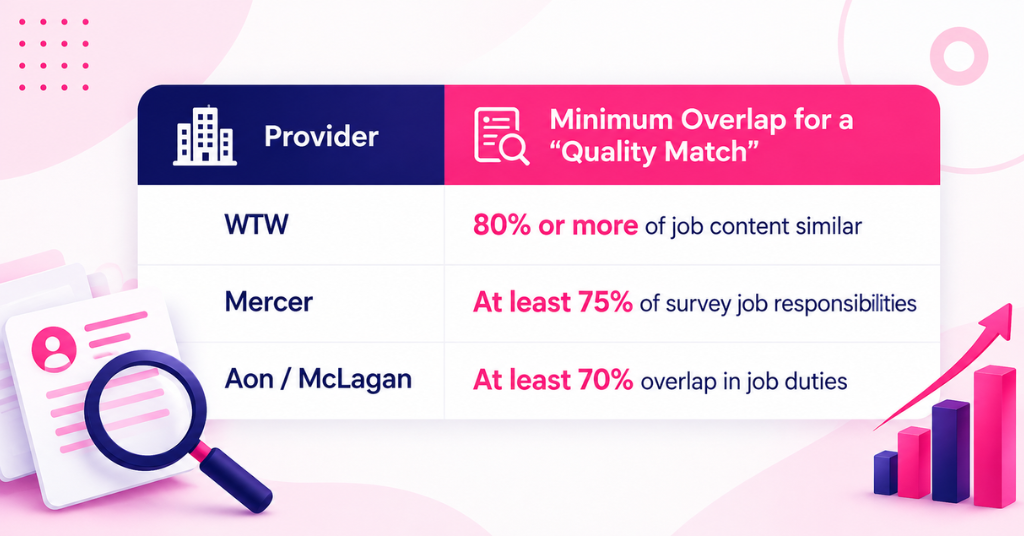
There is no universal definition of a good match. Whichever threshold an analyst is working from, they are still making a subjective call about what “similar” means for a role that rarely lines up cleanly with a catalog job — and that call gets made differently by every analyst who makes it.
Where Manual Matching Actually Breaks Down
- Subjectivity at scale: Two analysts working from the same job description can reasonably land on two different benchmark codes. Across thousands of employees and hundreds of participating companies, that inconsistency becomes invisible noise sitting underneath market data that looks perfectly precise.
- Time: The entire survey submission process, driven largely by job matching, is a multi-week project for most participants, according to Mercer — which means pricing decisions are often finalized against positioning that is already months old by the time the data comes back.
What Changes When AI Does the Matching
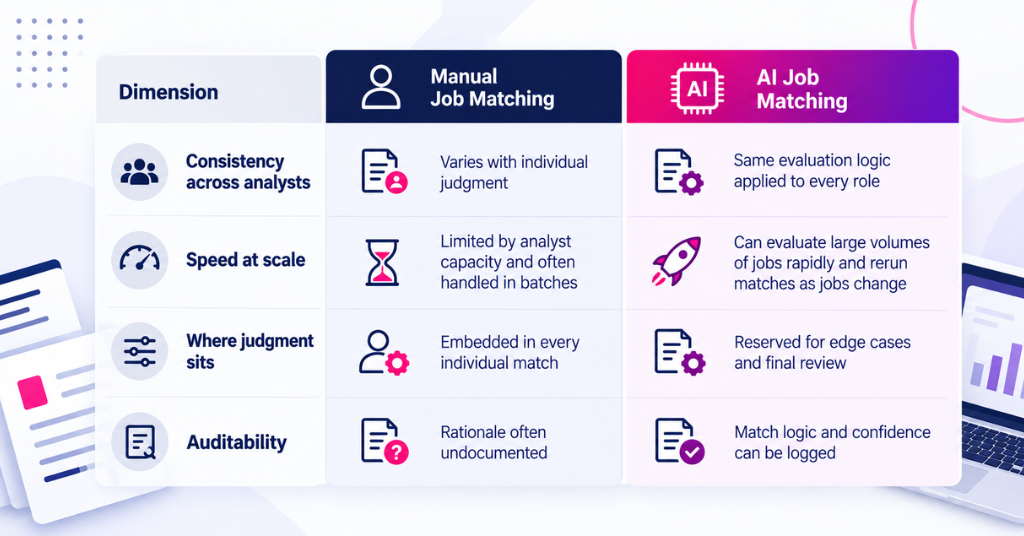
AI job matching software approaches the same problem differently. Instead of one analyst reading one job description against one catalog entry, an AI compensation platform can evaluate a role’s full scope — responsibilities, required skills, level, reporting line — against the entire catalog at once, and apply that same evaluation logic to the next ten thousand roles it sees.
That consistency is the real gain, more than the speed. A rule applied identically ten thousand times, even an imperfect rule, produces market pricing you can explain and defend. A rule applied slightly differently by a dozen different analysts does not, regardless of how experienced each of them is individually.
None of this makes the human step optional. The organizations getting real value from job matching technology are not removing a person from the loop — they are moving that person from doing the match to reviewing it, reserved for the genuine judgment calls AI should not be trusted to make unsupervised.
The Adoption Gap Comp Teams Can’t Afford to Ignore
The appetite for this shift already exists at the top of HR. According to SHRM’s 2026 State of AI in HR report, 92% of CHROs expect greater AI integration across the workforce this year, and 87% expect deeper AI adoption specifically within HR processes. Yet the same research found that a majority of organizations have not implemented AI within the HR function itself and have no plans to in 2026.
Job matching sits squarely inside that gap. It is repetitive, high-volume, and error-prone by design — precisely the workflow AI compensation software is suited to, and precisely the task most comp teams are still doing the old way while their own CHRO tells the board that AI adoption is a priority.
Getting Ahead of It
- Ask how matches are actually generated. A model that primarily reads job titles isn’t meaningfully different from a keyword search — ask whether it evaluates full scope, level, and reporting structure.
- Ask how disagreements get resolved. Every AI job matching system will occasionally get a match wrong; what matters is whether it flags low-confidence matches for review instead of presenting every output with equal certainty.
- Ask how the underlying catalog stays current. A model is only as current as what it’s matching against — find out how new and emerging roles get incorporated, and how often.
- Pilot it side by side before switching entirely. Run twenty already-benchmarked roles through the AI process and compare; wherever the two disagree is exactly where to ask why.
- Keep a named reviewer accountable for exceptions. Job matching technology should narrow the set of judgment calls a person has to make, not eliminate the need for someone to own them.
Better Market Pricing Starts With a Better Match
The choice between AI job matching and manual job matching isn’t really about speed, though speed is real and worth having. It’s about whether the market position your organization defends to its board, its employees, and its regulators was built on a match that can be explained and repeated — or one that happened to be made by whoever was available that week.
Connect with Payfederate to see how AI-powered job matching underpins a market pricing engine built for consistency at scale, with a trial period built in from the start.
Your Salary Benchmarking Is Only as Good as Your Job Descriptions
Michael Dressler, Director of Business Development, Payfederate®
The hidden data quality problem — and why generic AI makes it worse, not better.
Most compensation benchmarking problems are not benchmarking problems. They are job description problems.
Organizations invest significantly in market data — survey subscriptions, benchmarking platforms, analyst time. They treat that data as the authoritative input to pay decisions. But there is a step before the data that rarely gets the same attention: making sure the roles being benchmarked are accurately and consistently described.
When that step is skipped, the benchmarking process breaks down in ways that are invisible until the consequences appear elsewhere — pay equity complaints, retention losses, salary ranges that look competitive on paper but fail the moment an employee starts comparing notes.
Job Matching Is the Foundation of Market Pricing
Salary benchmarking works through job matching: comparing an internal role to an equivalent role in external survey data. The match determines which market data point your role is priced against.
Get the match right, and the data is meaningful. Get it wrong, and you are pricing your roles against the wrong population entirely.
| The established standard for a valid job match is an approximately 80% alignment between the internal job description and the survey benchmark — evaluated on actual responsibilities, scope, and qualifications. Not job titles alone. Source: ERIERI, Job Matching in Compensation Benchmarking |
Titles are notoriously unreliable for this purpose. A “Senior Manager” in one organization may have the scope of a “Director” benchmark in another. A “Data Analyst” in a mature analytics function may be doing work the market prices as “Data Scientist.”
When job descriptions are outdated or vague, the match becomes a judgment call — and inconsistency gets built into the pay structure, compounding over time.
Four Ways Poor Job Descriptions Corrupt Benchmarking
The damage is specific, and it is worth naming directly.
- Overstated scope: Inflated titles produce overstated benchmarks.When a role is described more broadly than the work warrants, it matches to a higher survey benchmark. Repeated across dozens of roles, this creates budget overruns and pay equity risk.
- Vague language: Vague descriptions produce imprecise matches.”Responsible for data-related tasks and analysis” gives an analyst almost nothing to work with. The resulting market rate could be off by 15% or more — and it will look authoritative.
- Stale descriptions: Outdated descriptions price yesterday’s role at today’s market.A software engineering role written three years ago likely undersells current skill requirements. The role ends up underpriced, and you wonder why attrition in that function keeps climbing.
- No standard format: Inconsistent descriptions produce inconsistent ranges.When similar responsibilities are described differently across business units, the same job produces different benchmarks. That inconsistency gets locked into the pay structure and defended as if it were intentional policy.
Why Generic AI Makes This Problem Worse
There is a temptation to reach for a general-purpose AI tool to clean up job descriptions. Drop a role into a large language model, get polished output in seconds.
The result looks professional. And the problem is not solved — it has a new shape.
| A generic LLM optimizes one job description in isolation. It has no awareness of the other 200 job descriptions in your organization, your leveling criteria, or how your “Senior Analyst” in Finance differs from the one in Marketing. What it produces is locally coherent — and catalog-incoherent. Catalog coherence is exactly what matters for benchmarking. |
When an LLM writes each description without reference to the rest of the catalog, level distinctions blur, scope language drifts, and the resulting descriptions cannot be matched to survey benchmarks in a consistent way. The output reads better than what it replaced while introducing a new kind of inconsistency.
RAG vs. Generic LLM: What the Difference Actually Means
Payfederate uses a Retrieval-Augmented Generation (RAG) architecture — a system that grounds every job description it produces in the full context of your existing job catalog. Before generating output, it retrieves relevant content from your structured job library: leveling language, scope definitions, career level distinctions.
The result is not just a better individual job description. It is a job catalog that is internally consistent — one that can actually be matched to survey benchmarks with confidence.
| Generic LLM (One Description at a Time) | Payfederate RAG (Whole Catalog Aware) |
| Optimizes each JD in isolation | Every JD is grounded in the full job catalog |
| No awareness of your leveling framework | Reads and respects your existing career levels |
| Scope language drifts across roles | Consistent scope language across comparable roles |
| Level distinctions blur over time | Level distinctions stay meaningful and defensible |
| Benchmark matches become inconsistent | Catalog coherence supports reliable job matching |
| Benchmark matches become inconsistent | Catalog coherence supports reliable job matching |
| Update one JD, unintended gaps appear elsewhere | Updates propagate with catalog coherence intact |
There is also a maintenance dimension that matters. When a role evolves and a description needs updating, a RAG-based system preserves coherence across the catalog. Generic AI cannot do that — each update is generated without reference to what surrounds it.
The Downstream Effects
Job description quality does not stay contained in the benchmarking process. It flows into everything that compensation data touches.
- Compensation planning cycles depend on managers making decisions within defined ranges. Those ranges are only as defensible as the benchmarking that produced them.
- Pay equity analysis requires grouping employees into comparable cohorts. When descriptions are incoherent, those cohorts are unreliable — and the equity analysis reflects the description problem, not the pay reality.
- Pay transparency compliance is increasingly non-negotiable. 60% of U.S. organizations now publish salary ranges in job postings, up from 45% in 2023. A posted range derived from a flawed benchmark is difficult to defend — to candidates, to employees, and to regulators.
| Only 22% of organizations describe their compensation approaches as advanced or innovative, despite 67% saying compensation and total rewards will become more important in the next two years. The gap often starts exactly here — at the job description level, before any market data enters the picture. |
Start in the Right Place
The practitioner advice on this is consistent: run your job description cleanup before benchmarking, not during it.
Trying to fix description quality while simultaneously running market pricing introduces errors at both stages. The better sequence is to establish a coherent, current job catalog first — and then benchmark from a position of confidence.
The organizations that get benchmarking right are not the ones with access to the most market data. They are the ones whose job catalog is accurate enough that market data can actually be applied to it.
That starts with better job descriptions. Not better data.
Connect with Payfederate
Inconsistent job descriptions make every downstream compensation decision harder to defend. Payfederate’s RAG-powered job architecture tools help you build and maintain a catalog that is coherent, current, and benchmarkable — so market pricing reflects reality.
Learn more at 1135556.us12.myftpupload.com/
Your Job Architecture Isn’t Broken. It’s Just Passive
Boyd Davis, Co-founder, Payfederate®
TL;DR
Most organizations have a job architecture collecting dust in a shared drive. The real question isn’t whether yours is accurate — it’s whether it’s actually working for you. ·
I’ve had some version of the same conversation probably a hundred times over the past few years. A compensation leader — thoughtful, experienced, clearly capable — walks me through their job architecture. The structure is solid. The career levels make sense. The job families are well-defined. And then I ask: “What did you change last quarter?” Long pause. “Well, we added a couple of new roles.” What about when you restructured that engineering org? Another pause. “Oh, we updated the spreadsheet. Eventually.”
That spreadsheet is the tell. It’s sitting in a shared drive, partially updated, with three different people’s initials scattered across the version history. The job architecture exists — but it isn’t really working.
This is what I’ve come to think of as a passive job architecture. And I’d argue it’s the dominant model in corporate America right now — not because HR leaders lack capability, but because until recently there was simply no better alternative.
The Static Assumption Baked into Every System
Here’s the thing that rarely gets said out loud: every major HR technology platform — whether you’re talking about Workday, SAP SuccessFactors, or a compensation benchmarking tool like Payscale or Bettercomp — treats job architecture as a fixed input. You can run analytics through the lens of job families and career levels. You can filter your salary data by function. But you can’t really model the architecture itself, or stress-test it against your market data, or see how a structural change ripples through your compensation bands.
The job architecture goes in, and then it largely just sits there. It becomes the wallpaper behind everything else — visible in reports, referenced in conversations, but not a tool anyone is actively using to drive decisions.
A 2024 Mercer survey found that fewer than one in three organizations revisit their job architecture on a defined schedule, and nearly half describe their process for updating it as ad hoc. Meanwhile, research from Willis Towers Watson suggests that organizations with misaligned job structures can spend up to 8% more on compensation than peers with tighter architecture — without any corresponding improvement in employee outcomes.
|
Fewer than 1 in 3 organizations revisit their job architecture on a defined schedule. |
~48% describe their architecture update process as “ad hoc” or undefined. |
Up to 8% excess compensation spend is linked to misaligned job structures. |
Those aren’t edge cases. That’s a systemic problem masquerading as a workflow inconvenience.
What “Active” Actually Means
When I talk about an active job architecture, I’m not suggesting companies should be reshuffling their job families every quarter. That would be chaos — and it would undermine the entire point of having an architecture in the first place. Stability and consistency are features, not limitations.
What I mean is something more precise: an active job architecture is one that drives outcomes rather than simply labeling them after the fact.
Think about how a strong job architecture should function in practice. When a hiring manager opens a new role, the architecture should be shaping the job description, informing the title and level, and surfacing the relevant market pricing automatically. When a manager wants to promote someone, the architecture should be the guide — not a document they dig up and interpret on their own, reaching conclusions that may or may not match what their colleagues in a different business unit are doing at the same time. When finance is modeling headcount scenarios, the architecture should be the framework through which those scenarios are built and evaluated.
| “None of that requires the architecture to be constantly changing. It requires it to be connected — integrated with the tools and the decisions that people are already making every day.” |
An active job architecture is also one that informs hiring, guides promotions, and shapes how the organization communicates about careers and growth. When those functions are aligned with the architecture, the architecture starts doing real work. When they’re not, you end up with the familiar fragmentation: three different representations of the same reality, none of them synchronized, all of them creating confusion for candidates, managers, and HR teams alike.
The Real Cost of Passive Architecture
I’ve watched organizations spend six months on a compensation benchmarking project only to discover, midway through, that their job architecture doesn’t map cleanly to any of the survey benchmarks they’ve purchased. So they either force-fit the match — introducing noise into every data point that follows — or they pause the whole project to fix the architecture first, losing months of calendar time and organizational momentum.
Neither outcome is good. Both are entirely avoidable. But they’re so common that most compensation teams have simply accepted them as part of the process.
The architecture and the market data should be living in the same environment, talking to each other, so that a change in one is immediately visible in the other. That’s not a technical pipe dream — it’s a design choice. Most platforms just haven’t made it.
The same disconnect shows up in job descriptions. I’ve seen companies where the official job architecture says one thing, the descriptions posted on their careers page say something slightly different, and the levels being communicated to candidates in offer letters say something else again. Three versions of the same organizational reality, none of them in sync. Each one maintained by a different person, on a different schedule, with a different understanding of what the architecture is actually supposed to say.
Integrated by Design, Not by Accident
At Payfederate, we built our platform around the premise that job architecture, compensation management, job descriptions, and offer communications shouldn’t be separate systems that HR has to manually keep aligned. They should be a single connected environment where market data informs structure, where changes propagate across the suite, and where the architecture is something people actually use — not something they maintain in parallel with everything else.
We’ve organized the platform into four modules — Job Architecture, Compensation, Job Descriptions, and Offers & Statements — because these functions are distinct enough to manage independently but interconnected enough that isolating them entirely creates exactly the fragmentation problem I’ve been describing. You can start with what you need most and build out from there. But the connections are always available when you’re ready for them.
That’s what integrated job architecture looks like in practice: not a perfectly rigid structure, and not a constantly shifting one, but a living framework that stays aligned with your talent strategy and your market data without requiring a team of specialists to hold it together manually.
The Future of Job Architecture Is Active Relevance
I do not think job architecture needs to be reinvented. What it needs is to be treated with greater strategic importance than it has historically received.
For years, many organizations built job architecture because it was necessary for governance, compensation alignment, and organizational consistency. But once it was established, it often became something teams referenced occasionally rather than something they actively used to shape workforce decisions.
That gap is becoming harder to ignore.
As organizations rethink work in response to AI, changing skill demands, compensation pressure, and growing expectations around internal mobility, job architecture can no longer sit quietly in the background as an administrative framework. It should play a much more active role in how companies define roles, evaluate progression, align compensation, and make long-term talent decisions.
To be clear, active job architecture does not mean constantly changing job structures. Stability, governance and consistency still matters. What should change is how intentionally organizations apply it.
When job architecture becomes part of everyday workforce strategy, it stops being a static reference point and starts becoming something much more valuable: a framework that helps leaders make clearer, more consistent, and better-informed decisions across hiring, compensation, career development, and organizational growth.
That is where I believe the real opportunity is.
The future of job architecture is not about making it more fluid. It is about making it more useful, more connected, and far more relevant to the decisions that shape business and talent outcomes.
At Payfederate, we believe job architecture should do more than organize work. It should help organizations make better workforce decisions with greater clarity, consistency, and market alignment. If your team is rethinking how job architecture connects to compensation, career growth, and talent strategy, it may be worth exploring what a more active approach can look like in practice.
Explore Payfederate and see how job architecture, compensation, and workforce decisions can work together in one connected framework.
Keeping Work, Pay, and People in Sync: The Role of Job Architecture
Boyd Davis, CEO Payfederate
Every organization talks about agility, but very few achieve it. Teams move fast, new skills appear out of nowhere, and roles change shape before job titles catch up. Somewhere in that chaos, companies still need to stay fair, structured, and clear about what work truly means.
That is what job architecture helps achieve. It gives shape to how work is defined and rewarded so that people, pay, and purpose stay aligned even when the business moves in new directions.
Understanding the Basics
At its heart, job architecture is the structure that explains how roles fit together. It lays out what differentiates one job from another, how responsibilities grow with each level, and what career paths look like across functions.
Think of it as a map. It helps people understand where they are today and where they can go next. Without that map, things quickly get fuzzy. Two employees might have the same title but do very different work. Pay levels drift. Promotions feel subjective.
A well-built architecture doesn’t fix every problem, but it gives leaders and employees a shared language. It puts logic behind how jobs are designed, evaluated, and rewarded.
Bringing Fairness and Clarity to Pay
In the compensation management cycle, job architecture does the heavy lifting behind the scenes. It connects the dots between job responsibilities, market data, and pay ranges so that decisions feel consistent rather than arbitrary.
That consistency matters. When employees can see the reasoning behind pay decisions, trust grows. When managers have a framework to work within, fairness becomes easier to maintain. It also supports pay equity — something that has moved from a compliance box to a cultural expectation.
Technology now plays a growing role. AI job description tools can help draft roles or analyze patterns in job data, but they are not a replacement for structure. AI can only improve accuracy when it’s built on clear definitions. Without them, it risks turning small inconsistencies into bigger ones. The human framework must come first; technology simply makes it easier to maintain.
Structure That Encourages Movement
There’s a common misconception that job architecture creates rigidity. In reality, it does the opposite. Clear structure gives organizations room to move quickly because the basics are already in place.
When new roles appear or business priorities change, leaders don’t have to start from zero. They know where a new job fits, how it compares to existing roles, and what a fair pay level looks like. That clarity shortens the time between decision and action.
It also helps employees plan their own growth. When career levels and skill expectations are visible, people can see what progress looks like. This sense of direction supports engagement and reduces turnover—especially in times when change feels constant.
Technology as an Enabler
Modern HR platforms now make it easier to bring structure and insight together. Solutions like Payfederate allow organizations to connect their job architecture with compensation data and benchmarking tools. The goal isn’t to automate judgment, but to make informed decisions based on real evidence.
Data works best when paired with experience and context. When leaders use technology to enhance, not replace, human thinking, pay decisions become more transparent and defensible.
Why This Matters Now
Work has never been as fluid as it is today. Skills shift, hybrid models blur boundaries, and expectations around fairness and transparency are higher than ever. In this environment, job architecture is no longer just an HR framework — it’s a stabilizing force.
It links business strategy to human capability. It makes sure every role has meaning, every pay decision has logic, and every employee can see a future that makes sense.
Done thoughtfully, job architecture keeps an organization grounded while everything around it changes. It’s not a trend or a tool — it’s the structure that allows agility to actually work.
Why Job Descriptions Are the Foundation of Modern Compensation Strategy
Boyd Davis, CEO Payfederate
When I sit down with compensation leaders, one theme comes up again and again: job descriptions. They don’t always get the spotlight, but they quietly determine whether everything else in compensation and HR runs smoothly—or falls apart.
The truth is, job descriptions are more than a formality. They’re the backbone of enterprise compensation management, and they set the stage for how organizations manage pay, build career paths, and keep employees engaged. If the descriptions aren’t solid, even the most advanced compensation management software can only go so far.
What Makes a Job Description Work
At Payfederate, we talk about the three Cs of good job descriptions:
Complete: The description should actually capture what matters—responsibilities, skills, certifications. Without that, salary surveys and salary benchmarking don’t mean much.
Consistent: Across a company, job descriptions need to follow the same standard. Otherwise, job leveling and pay ranges feel arbitrary.
Coherent: A good description makes sense within a career path. Moving from analyst to manager, or from manager to director, should show a real progression in responsibilities and skills. That’s how you build meaningful career architecture and career mapping.
Where Companies Struggle
It’s not hard to see why job descriptions get messy. A few patterns come up often:
-
Job postings are mistaken for job descriptions: A posting is about filling a role today. A job description is about defining the role itself, so it can be compared across the labor market or internally.
-
Too much signaling: Relying on degrees or years of experience instead of focusing on the skills required for the job. That’s a problem if you want to move toward skills based compensation or performance based compensation.
-
Outdated content: Roles evolve quickly. If descriptions aren’t reviewed, you may be benchmarking pay for work people aren’t actually doing anymore—leading to pay compression or misaligned salary ranges.
-
Too many authors: Hiring managers or recruiters often write descriptions when they need to hire fast. The compensation team ends up reacting rather than shaping the framework.
Where AI Fits In
Now, it’s fair to ask: can’t AI just write these? Tools like ChatGPT can churn out a decent draft for one role. The problem is consistency. Without a structured approach, job descriptions end up all over the place. And unless you’re using a secure, purpose-built platform, you risk sharing sensitive comp data.
Old-school job catalogs don’t really solve it either. Even with AI layered on top, they’re still tied to outdated pricing models.
That’s why we built AI for HR directly into Payfederate. Our AI job description capability is designed to work inside a full compensation management platform. It builds on your existing descriptions, your career leveling, your compensation guidelines. The result isn’t just faster drafting—it’s complete, consistent, and coherent descriptions that feed directly into your compensation strategy.
Why This Matters
Job descriptions aren’t glamorous. But they influence everything: salary benchmarking tools, AI job matching, skill based pay, career progression, and salary transparency. They’re the first step in making sure employees feel their work is recognized and rewarded fairly.
At Payfederate, we see job descriptions as the foundation of compensation strategy. If you get them right, everything else—from comp data to compensation consulting—becomes sharper, fairer, and easier to manage.
If your job descriptions are overdue for a reset, let’s talk.
Reach out here and see how Payfederate can help you bring clarity, consistency, and confidence to the way you manage compensation.
Why Skills-Based Compensation is the Missing Link in Your Talent Management Strategy?
Michael Dressler, Director of Business Development, Payfederate
In today’s rapidly evolving job market, traditional compensation models are struggling to keep pace with the demands of a skills-driven economy. According to a 2025 workforce report by Mercer, over 70% of organizations are shifting towards skills-based talent strategies, recognizing that pay structures based solely on job titles and tenure no longer reflect true employee value. As businesses compete for top talent, skills-based compensation has emerged as the key to unlocking employee potential, improving retention, and fostering a future-ready workforce.
The Problem with Traditional Compensation Models
For decades, compensation management has been driven by inflexible job descriptions, fixed pay grades, and performance appraisals that too frequently don’t account for an employee’s actual contribution. The consequences? High turnover, disengaged employees, and a worsening gap between compensation and productivity.
With industries changing at an unprecedented pace, companies need adaptable and dynamic compensation structures. Employees are reskilling and upskilling at an unprecedented rate, but many firms still placed more value on a person’s tenure rather than their skills. Such practices not only drive frustration to highly skilled employees who feel under valued but also encourages them to look outside for better prospects.
What is Skills-Based Compensation?
Skills-based compensation is a modern, data-driven approach that connects pay to an employee’s skills rather than their position or time served in the company. It allows companies to recognize employees equitably and honestly, based on their skills, mastery, and actual contributions instead of employment duration or vague evaluations.
This model not only benefits employees by providing clearer career progression but also helps businesses close skill gaps, enhance workforce agility, and attract high-caliber talent.
How Skills-Based Compensation Enhances Your Talent Management Strategy
- Pay People for What They’re Worth
When compensation reflects real skills, employees feel valued and motivated to grow. A fairer pay structure leads to a stronger, more skilled workforce. - Clear Growth, Better Careers
No more guesswork—employees know exactly which skills to build for better pay and career progression. A transparent path keeps them engaged and invested. - Stay Ready for What’s Next
As industries evolve, so should your workforce. A skills-based approach helps businesses stay agile and prepared for the future. - Keep Your Best People Happy
When employees see their skills rewarded, they stick around. Skills-based pay boosts morale, reduces turnover, and creates a workplace where people thrive. - Fair Pay for Everyone, No Bias
Remove pay gaps and subjectivity. A skills-first model ensures equal opportunities, fostering a diverse, inclusive, and merit-based workplace.
Simplifying Skills Based Compensation with Payfederate
Shifting to a skills-based compensation model may seem complex, but with the right tools, it becomes effortless. Payfederate’s platform is designed to simplify compensation management by providing:
- AI-supported job descriptions: Ensure skills are appropriately represented, and drive consistency and quality into all job descriptions
- AI-job matching: Match internal jobs to benchmark jobs based on skills and responsibilities, not just title and experience
- Compensation scenarios: Model scenarios for performance based pay relative to position in range and position relative to market
- Pay ranges and career level definitions available for sharing: Drive productive pay transparency for career development
Looking Ahead
The shift towards skills-based compensation isn’t just a trend—it’s a necessity. Organizations that fail to adopt a skills-first approach risk losing top talent and falling behind in an increasingly competitive market. By embracing this model, businesses can build a resilient, motivated, and future-proof workforce that thrives on continuous learning and growth.
Take the Next Step Toward Fair & Future-Ready Pay!
Your workforce deserves a compensation strategy that truly reflects their skills and contributions. With Payfederate, you can seamlessly transition to a transparent, skills-based pay model that drives retention, motivation, and business success.
Curious to see how this works? Try Payfederate for free and experience a skills-based approach in action.
How Job Architecture Supports Strategic Workforce Planning
Michael Dressler, Director of Business Development, Payfederate
In today’s competitive business environment, effective workforce planning goes beyond merely filling open positions; it’s about ensuring that talent aligns with the organization’s strategic objectives. Unfortunately, many companies face difficulties in workforce planning due to a lack of a well-defined job architecture. Without a solid framework, businesses encounter problems like unclear career progression, pay disparities, inefficient hiring processes, and compliance issues. These challenges not only affect employee morale but also limit an organization’s capacity to accurately forecast and manage its workforce.
So, what role does job architecture play in strategic workforce planning? Let’s delve into this crucial framework and its significance in enhancing talent management.
Understanding Job Architecture
At its core, job architecture is a structured framework that defines and organizes roles within a company. It includes job titles, responsibilities, and required skills, ensuring consistency in role evaluation and compensation. A well-structured job architecture promotes transparency and fairness across departments, creating a standardized approach to managing talent.
Why Job Architecture is Essential
Think of job architecture as the foundation of a house—before building the frame, you need a solid base. Similarly, a well-structured job architecture serves as the groundwork for crucial HR functions such as compensation consulting, talent management, and salary transparency. It provides several key benefits:
- Enhances employee engagement and retention by offering clear career progression.
- Streamlines HR processes, making hiring and promotions more efficient.
- Helps manage workforce costs by optimizing role structures and pay scales.
- Enables precise talent investments by identifying skill gaps.
- Drives compliance strategies for pay equity and salary transparency.
The Role of Strategic Workforce Planning (SWP)
Strategic Workforce Planning (SWP) is the process of analyzing current and future workforce needs, identifying skill gaps, and developing strategies to ensure the right talent is in place to meet business goals. It involves talent acquisition and retention strategies, cost optimization, workforce efficiency, risk mitigation, and succession planning. Furthermore, it enables business agility through proactive workforce management, helping organizations stay ahead in a rapidly evolving job market.
How Job Architecture Strengthens Strategic Workforce Planning
A well-designed job architecture framework directly contributes to strategic workforce planning by providing clarity and structure to an organization’s talent strategy. It enables businesses to forecast future workforce needs based on industry trends and business objectives while improving hiring and retention by ensuring standardized roles and salary transparency. Employees are more engaged when they have clear growth opportunities within the organization, making career path development a key benefit of job architecture.
Additionally, a structured job framework ensures pay equity by defining job levels and responsibilities, fostering trust and reducing disparities. By clearly outlining roles and expectations, organizations can also identify skill gaps and implement targeted training and development programs to address workforce needs proactively.
Job Architecture and Strategic Workforce Planning in Practice
When combined effectively, job architecture and strategic workforce planning can drive long-term organizational success.
- Identifying Competency Gaps: HR can determine areas that require skill or role adjustments through a mapping process that incorporates employees’ skills and roles.
- Anticipating Future Talent Gaps: A well-defined structure helps organizations plan for market changes by anticipating talent shortages in advance.
- Developing Targeted Training Programs: Job architecture enables HR to create learning opportunities that support both business needs and employees’ career development.
- Succession Planning: An effective framework ensures a smooth transition when key personnel retire or leave by identifying critical roles and potential successors.
Ensuring a Transparent and Updated Job Architecture Framework
Given its critical role in workforce planning, maintaining an up-to-date and transparent job architecture is essential. Companies typically take one of two approaches:
Building and Managing In-House: If an organization has the resources and expertise, it can use advanced compensation management and workforce planning software like Payfederate to design, maintain, and optimize its job architecture.
Engaging Compensation Consultants: Many organizations choose to work with compensation consulting experts for an objective, unbiased assessment of their job architecture needs. Consultants help structure fair and equitable job evaluations, define clear career paths, and ensure compliance with pay equity regulations.
Why Do Companies Choose Compensation Consultants?
Partnering with a compensation consultant offers businesses valuable expertise in workforce planning and job structuring. These external experts provide objective insights, ensuring that job roles align with industry standards and best practices. They play a crucial role in career path development by designing structured progression plans that enhance employee motivation and retention. Additionally, consultants help establish fair and transparent job evaluations, eliminating internal pay disparities and ensuring compliance with regulations. A well-defined job architecture also brings clarity to roles and responsibilities, reducing overlap between functions, minimizing confusion, and improving overall efficiency.
Looking Ahead
A consistently updated and transparent job architecture framework is not just a tool—it’s a strategic necessity. By integrating job architecture with strategic workforce planning, organizations can optimize hiring, retention, career development, and compliance. Whether managed in-house with solutions like Payfederate or through expert compensation consultants, ensuring a structured and fair approach to job roles and compensation management is key to building a resilient and future-ready workforce.
- Industry Benchmarking: Compensation consultants provide data-driven insights to ensure salary structures remain competitive within the industry.
- Customized Workforce Strategies: They tailor job architecture frameworks to align with business goals and evolving market trends.
- Advanced Compensation Planning: Experts help design equitable pay structures that attract and retain top talent while managing labor costs effectively.
- Regulatory Compliance Assurance: Consultants ensure job evaluations and compensation policies adhere to local labor laws and pay equity regulations.
- Optimized Job Frameworks: They streamline job titles, responsibilities, and career paths, creating a structured and scalable workforce planning model.
Unlock the Power of Strategic Workforce Planning with Payfederate!
Is your organization equipped with a robust job architecture framework? If not, it’s time to take action and invest in a structure that supports long-term business success. Discover how our cutting-edge solutions can help you build a transparent, scalable, and future-ready job architecture. Schedule a Demo Today!
Read our previous blog, Rethinking Job Descriptions: The Shift to Skills-Based Talent Management, to discover how transitioning to a skills-based approach can help organizations build agile, future-ready teams.
Rethinking Job Descriptions: The Shift to Skills-Based Talent Management
Boyd Davis, CEO Payfederate
Fifteen years ago, the world began to shift its approach to hiring. Credentials—those polished, often expensive, badges of achievement—started losing their dominance as the primary criteria for job roles. Then, in the aftermath of COVID-19, the pace of this transformation picked up dramatically.
In 2021, IBM announced that half of its U.S. roles no longer required a college degree, a journey that began five years earlier. Fast forward to 2023, Deloitte was championing the concept of “Navigating the End of Jobs,” highlighting a monumental shift in how organizations view talent. Skills-based talent management—hiring, developing, and promoting employees based on capabilities rather than credentials—became the buzzword. But as we ride this wave of change, one question lingers: Have we truly made meaningful progress?
The Promise and the Gap in Skills-Based Hiring
Data tells a mixed story. On the one hand, job postings that don’t require a degree have quadrupled. That’s progress. Yet, for every 100 such roles posted, only four additional candidates without degrees were hired. The promise of equitable and skills-focused hiring feels real, but the impact remains muted.
At the heart of this transformation lies the “skills taxonomy,” a comprehensive list of skills that an organization can assess and apply to its workforce. These taxonomies can span hundreds or even thousands of skills, offering organizations an incredible opportunity to match talent to roles more effectively. However, adoption rates remain low. By 2022, only 1 in 10 organizations had implemented a skills taxonomy. Among Payfederate customers, many of whom have a few thousand employees or fewer, the numbers are even lower.
Adopting a skills-based approach comes with its challenges. Identifying the skills required for a role is one hurdle; accurately assessing those skills in candidates and employees is another.
The Missing Link: Skills Journey, Job Architecture, and Equitable Rewards
The shift to skills-based talent management isn’t just about improving job descriptions—it’s about rethinking job architecture as a whole. A well-designed job architecture is essential to support skills-based career journeys. By establishing clear, competency-based career levels and aligning them with skills, organizations can enable employees to see logical growth paths within the company. But this journey must also tie back to a central pillar of organizational fairness: equitable, competitive pay ranges. For skills based compensation management to truly succeed, roles must be rationalized against market benchmarks, ensuring employees are appropriately rewarded for their contributions. Only when job architecture integrates skills, career paths, and fair compensation management can the promise of skills-based talent management reach its full potential.
At Payfederate, this holistic approach is embedded in our mission to empower organizations and their people.
Why It All Starts with Job Descriptions
If you’re reading this, you probably already believe that moving from credential-based hiring to a skills-based model is both equitable and effective. The question isn’t about “why” but “how.” And the answer starts with job descriptions.
Let me be clear: I’ve never subscribed to the idea that jobs will one day be replaced by collections of skills, like recipes with exact measurements. You’re not going to see listings that say, “2 cups of project management, 1 cup of technical communication, 3 tablespoons of team motivation, and a pinch of creativity.”
Instead, job descriptions will evolve. They’ll outline the skills required, responsibilities, and necessary certifications. Truck drivers will still need a CDL. Nurses will still need to pass the NCLEX. Lawyers will still need to pass the bar. These certifications aren’t about signaling; they’re about competence. The real task is ensuring that job descriptions are accurate, well-crafted, and reflect the true needs of the role.
The Role of AI in Modernizing Job Descriptions
Here’s where AI and specifically AI job matching becomes a game-changer. Every customer Payfederate works with starts their journey with some sort of job description challenge. In the worst cases, there are no job descriptions at all—a surprisingly common scenario.
Cleaning up job descriptions is tedious, time-consuming, and often suffers from a lack of clear ownership within organizations. That’s why a purpose-built AI solution can make all the difference. With the right tools, organizations can:
- Normalize job descriptions to create consistency across the board.
- Enable collaboration among teams to ensure input from multiple perspectives.
- Conduct quality audits to ensure descriptions meet organizational standards.
- Enforce policies to keep job descriptions aligned with company guidelines.
Once job descriptions are centralized in a platform, it’s easier to avoid duplicative roles and maintain a consistent quality standard for new postings. Authorship becomes collaborative, and clear job descriptions can seamlessly transform into job postings.
Moreover, if job descriptions emphasize skills, an organization’s broader “skills library” can be extracted and refined. Soft skills—like leadership and communication—can be described with more specificity and consistency as the AI learns from existing descriptions and improves over time.
The Bigger Picture: Empowering Employees and Organizations
A coherent job catalog, complete with accurate, skills-based descriptions, does more than streamline hiring. It lays the foundation for transformational changes across the organization:
- Pay Benchmarking: With a clear understanding of roles and skills, organizations can set fair and competitive compensation.
- Career Pathing: Skills-based job descriptions make it easier to build logical career paths and job architectures.
- Employee Empowerment: When employees see their skills reflected in their roles—and understand the skills required for future roles—they gain a greater sense of control over their careers.
At Payfederate, we understand that skills-based talent management can feel like a daunting journey, especially for organizations without massive HR teams. That’s why we advocate for a practical, step-by-step approach.
Take the First Step with Payfederate
The path to skills based compensation and talent management begins with job descriptions. They are the foundation of hiring, development, and retention strategies. And while this might seem like a small step, it’s the most critical one.
With platforms like Payfederate, you’re not just creating job descriptions—you’re building the infrastructure for a fairer, more effective, and future-ready organization. Today, let’s start with your job descriptions and move forward together.
Check out our latest blog, The Road Ahead in 2025: Key Trends in Enterprise Compensation Management, where we explore the future of enterprise compensation. Learn about the rising significance of salary transparency, the role of AI in compensation strategies, and the need for innovative salary benchmarking approaches.